Philip S. Miller Park Trails in Castle Rock Are Changing
September 3, 2026
September 3, 2026
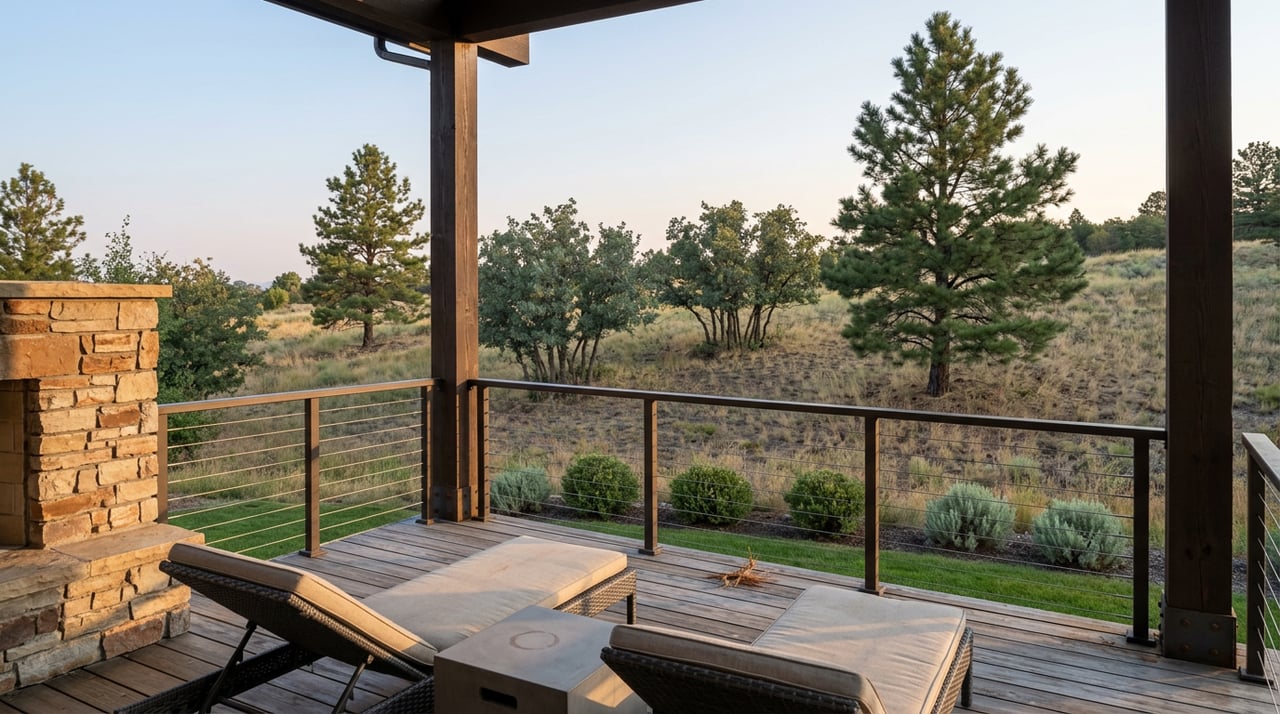
At 6 a.m., Challenge Hill belongs to whoever climbs it first. The steps are labeled every ten, all 200 of them, rising 178 feet up the hillside inside Philip S. Miller Park. No dogs are allowed on the stairs themselves, a rule the town has enforced since the feature opened, so the only company on a weekday morning is the occasional trail runner catching their breath at step 90 before finishing the climb. From the top, Pikes Peak sits on the horizon and the rest of the Front Range spreads out behind it. It is, by most accounts, the best free workout in town.
That version of Challenge Hill has an expiration date, and it is not a distant one.
The singletrack that wraps around Challenge Hill has not materially changed since the park's original build more than a decade ago. Eight miles of native-surface trail split into four interconnected loops cover the park's 300 acres, with an additional mile of paved, accessible trail circling the site for anyone who prefers pavement to dirt. That network was sized for the Castle Rock that existed when it opened, a town that was still years away from the population it has today.
The park itself has stayed busy in the meantime. It is the kind of place locals default to without thinking much about it: a lap before work, a dog walk after dinner, a Saturday climb up the stairs with a friend. The trails have absorbed that growth quietly, mostly because nobody was watching the math.
The math is easier to see now that it has a street address. On October 28, 2025, the Town of Castle Rock broke ground on the Castle Rock Sports Center, a 145,000-square-foot facility going up at 222 Brickyard Circle, part of a larger mixed-use project called the Brickyard on the former Acme Brick factory site off Prairie Hawk Drive. The facility is expected to open in the summer of 2027 and will include two competition gymnasiums for basketball, pickleball and volleyball, a 25-yard by 25-meter competitive pool with a warm-up pool and a one-meter springboard, an indoor walking track, and locker rooms built for tournament-level use. It is distinct from the Miller Activity Complex already inside the park, which the town describes as the family-oriented facility with its leisure pool and turf fields. The Sports Center is aimed at a different crowd: club teams, swim meets, adult leagues.
Here is the number that puts the project in context. According to the town's own materials, Castle Rock has not built a new gymnasium or competitive pool since 1988, when the population sat around 8,000 people. By the time the Sports Center opens in 2027, the town expects to have approximately 90,000 residents. That is not incremental growth. That is a town roughly eleven times larger than the last time it needed to build this kind of capacity, and it is choosing to build it directly beside the park that already carries the town's daily foot traffic.
The project's own description makes the connection explicit rather than incidental. Town materials note that the Brickyard build includes a new trail, roughly a mile long, linking the development to downtown Castle Rock and directly into Philip S. Miller Park. The $75 million facility cost is being funded through impact fees, future sales and lodging taxes generated by the Brickyard development, and financing through the Castle Rock Urban Renewal Authority. None of it comes from raising money independent of the growth causing it.
The Brickyard sits on one edge of the park. Miller's Landing sits on the other. The 65-acre site at the northwest corner of I-25 and Plum Creek Parkway was approved back in 2017 as a four-phase, roughly $300 million project. The developer has not published a final residential unit count, but the mix includes a hotel, office space, retail, and housing, all pitched around walkable access to the same trail system Challenge Hill sits inside. A Castle Rock trail advocate, quoted in a Pinkbike post, describes Miller's Landing as an "adventure-focused lifestyle district," built specifically to draw on the park's energy next door.
Tallying the public plans for the Brickyard and Miller's Landing side by side, that same advocate put the combined residential and hotel unit count within walking distance of the park at somewhere near 1,500. That estimate is not an official town figure, but it lines up with what is publicly documented on each project independently: the Brickyard alone is planning a 298-unit apartment building, delivered in two phases through the spring of 2028, with rents ranging from $1,600 to $3,150 a month, plus more than 100 additional for-sale condos on the same site.
The two projects are also already linked to the park's trail system in a way most residents walking it today probably do not realize. According to the town's own project page, the Miller's Landing side of a half-mile paved connector toward Prairie Hawk Drive, funded jointly with the Brickyard, has already been built. It is not open to the public yet. When it does open, it will feed directly into the existing eight miles of singletrack that have not grown since the park's original build.
It helps to separate what is confirmed and under construction from what is still on paper.
| Status | Project detail |
|---|---|
| Under construction | Castle Rock Sports Center, 145,000 sq ft, opening summer 2027 |
| Under construction | Brickyard Apartments foundations, 298 units, phase one summer 2027 |
| Built but not yet open | Miller's Landing's half of the paved trail connector toward Prairie Hawk Drive |
| Approved, not yet broken ground | Miller's Landing residential and hotel components |
That table is the difference between a headline and a timeline. The Sports Center and the first Brickyard apartments are not proposals anymore. They are concrete and steel with a delivery date. The trail connector is finished but sitting unused. Miller's Landing's housing is still a plan on file, which means the full 1,500-unit estimate is a ceiling, not a floor, and it will take years to materialize in full.
None of this means Challenge Hill stops being worth the climb. It means the crowd shows up sooner than most people expect, probably starting in 2027 when the Sports Center and the first Brickyard residents arrive within walking distance of the same stairs.
For anyone who wants the version of the park that exists before that happens, the park's Gold Loop already connects across the Wolfensberger Pedestrian Bridge to Ridgeline Open Space, stretching the combined trail system to roughly 17 miles across about 650 acres. It is a longer walk from the parking lot at the Miller Activity Complex, which is exactly why it stays quieter.
And after the climb, the routine that has not changed is still the one worth keeping. The B&B Cafe on Wilcox Street has been serving breakfast in Castle Rock's historic downtown for more than 55 years, tin ceiling and original marble bar included. Six new restaurants are already under contract for the Brickyard itself, part of the same development bringing the Sports Center. The park's stairs may get busier before the new places open, but the old cafe on Wilcox will likely be there through all of it.
Castle Rock is not becoming a different town. It is becoming a bigger version of the one that already exists, and the park in the middle of it is where that growth will show up first. If you are trying to make sense of what a project like the Brickyard means for the value or feel of a specific block near it, that is the kind of on-the-ground context Don Bobeda tracks for people who already call Castle Rock home.
Stay up to date on the latest real estate trends.
We pride ourselves in providing personalized solutions that bring our clients closer to their dream properties and enhance their long-term wealth.